
Pretty much every approach to SEO campaigns involves time-consuming and repetitive tasks, which means you either spend weeks (or even months) on projects yourself or you have to hire a team to help you do it faster.
While a lot has changed with the dawn of AI, digital marketers are often still stuck in a process that involves only partial SEO automation.
You’re still left with using multiple different SEO services and having to piece the output together.
However, when you fully map out all the tasks you can automate, SEO projects can quickly be cut down to less than an hour of work.
It might sound like hype, but I’ve got some pretty compelling evidence.
What is SEO Automation?
SEO automation refers to the use of software and AI tools that automate certain common tasks. There have long been SEO automation tools for things like KW research, but they mostly only take care of some of the tasks.
The main aim is to automate SEO tasks in a way that involves as little manual intervention as possible.
For example, think of entering a main focus keyword in an SEO tool and then receiving a long list of keywords for that topic that you can then use for content creation.
Now, you might think that the goal of automation might be to replace SEOs – but that’s quite far from reality.
The invention of computers and spreadsheets didn’t eliminate bookkeepers and accountants.
Similarly, when you automate SEO tasks, you free up professional marketers to focus on strategies, research, and coming up with creative solutions.
Search engine optimization is constantly evolving, and having more time to spend on refining a strategy, rather than analyzing 10,000 plus keywords, endless hours of content writing, and all the other technical tasks, makes a huge difference in project success and scalability.
How Has AI Changed The Automation Landscape?
AI has probably been the biggest disrupter in the SEO industry. It has made a lot of automation tasks incredibly cheap, fast, and effective.
You can have a 2,000-word blog post written in seconds, and with a bit more time spent on the formatting, it’s ready to post.
You can even use AI chatbots to help you analyze long lists of keywords and categorize them into groups.
But there’s a problem with most SEO automation tools.
They often focus on a subset of tasks in one area of SEO, and you’re still left with stitching all that information together into a strategy.
At the end of it all, you’re often left guessing, struggling to stay organized, and even worried about how all the automation will impact your rankings on the search engine results pages.
There is a solution to this, but let me first go through a list of tasks that are ideal for automation.
Top SEO Tasks To Automate
The following list contains some of the most time-consuming and repetitive tasks that seriously slow down your SEO performance.
Just imagine how much sooner you’ll see ranking improvements if you could get these tasks down to minutes rather than hours and days.
1. Keyword Research
Keyword research is the foundation of every SEO campaign, and it’s also one of the most time-consuming parts to get right.
The job itself is simple to describe: find the words and phrases your audience is typing into Google, so you know what to build your content and site structure around.
Doing it well is where the hours disappear.
Most keyword tools hand you a massive export of raw terms, sometimes thousands of them, with search volume and a difficulty score attached. That sounds helpful until you realize the list is just the starting point.
You still have to read through every term, discard the irrelevant ones, separate buyer-intent keywords from browsers, and work out which keywords belong together on the same page.
That last part, grouping related keywords into topical clusters, is the step that eats entire afternoons. It usually means a spreadsheet, dozens of tabs, and endless copying and pasting from one to another.
True automation wouldn’t just hand you the keywords. It would extract them, analyze them, and cluster them into ready-to-use groups, turning days of sorting into a few seconds of processing.
The good news is that there is an SEO automation software that turns those days of repetitive work into seconds.
What Xagio does is research the top-ranking websites in your niche, extract the relevant ranking keywords, and cluster them into groups. Each keyword is listed with the search volume, and you can automate competition analysis as well (more on this in the next section).
In just a few seconds, you can have a complete blueprint of all the pages you need for a niche, the keywords to target, and data to help you decide which KWs are the easiest ones to go after.
2. Keyword Competition Analysis
Finding a long list of keywords is only half the battle. The other half is working out which ones you can realistically rank for.
This is where a lot of SEO campaigns go wrong.
Chase keywords that are too competitive and you’ll pour months into pages that never crack the first page. Ignore competition entirely and you’re just guessing.
The challenge is that competition is harder to measure than search volume. Most tools give you a difficulty score, but those scores are often based on complex formulas that lean heavily on backlink data, and they can be wildly inconsistent from one tool to the next.
The manual alternative is to check the search results yourself for every keyword. You look at who is ranking, how strong those pages are, and whether smaller sites are holding positions, which is a strong signal that the keyword is winnable.
Done by hand, that means running search after search, noting which results are weak, and doing the same calculation over and over for every term on your list.
For a project with hundreds of keywords, that alone can take days.
With Xagio’s Project Planner SEO tool, you can automate the competition analysis for every single keyword in a project. Within seconds, Xagio will calculate competition metrics and display the best opportunities with a small gold bar icon.
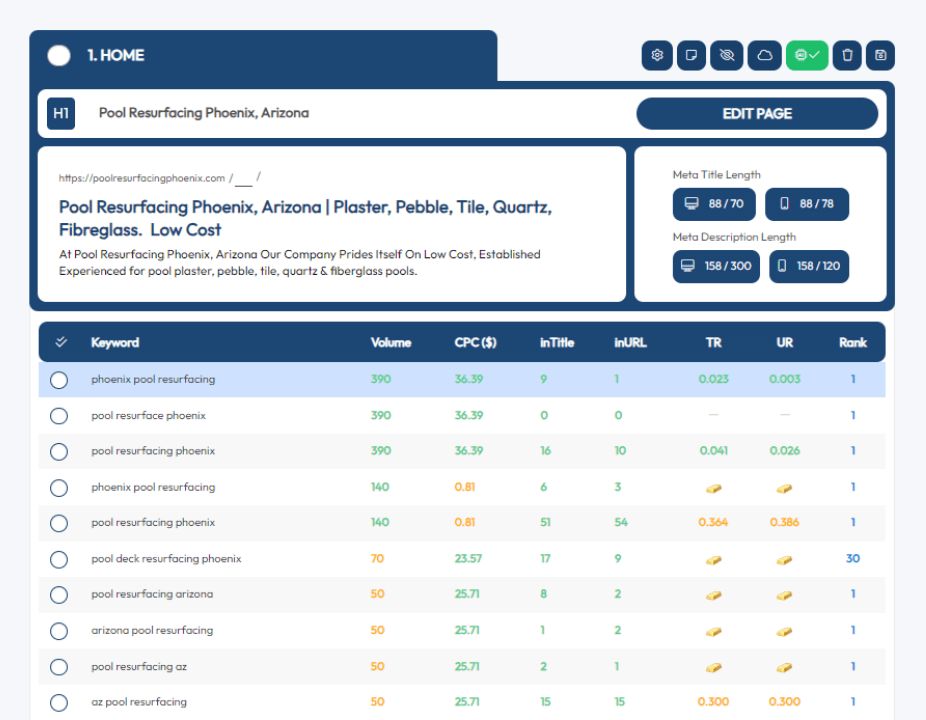
This allows you to make data-driven decisions by simply looking at the calculated information. It takes the guesswork out of the process and frees you up to make decisions faster than ever before.
3. Content Creation
Even with a perfect keyword plan in hand, you still face the single most time-consuming task in all of SEO: actually creating the content.
This is the stage where most projects stall.
Every page on your blueprint needs well-written, genuinely useful content that satisfies search intent. Multiply that across a site with dozens of pages and you’re looking at weeks of work, or a significant bill if you outsource it to writers.
AI writing tools have changed the math here, and a first draft that once took hours can now be generated in seconds.
But raw AI output comes with its own problems.
The quality and consistency vary wildly depending on how you prompt it, so you need to understand prompt engineering to get usable results. Then there’s the editing, fact-checking for hallucinations, removing the generic filler, and formatting everything for the page.
It‘s faster than writing from scratch, but it’s still a slow, hands-on cycle of generating, checking, and reformatting one page at a time.
Xagio makes this part infinitely easier.
We have developed an AI content tool that uses advanced prompts that we have put through extensive testing. All you need to do is click a button, and Xagio will take your keyword cluster for a page and generate highly optimized and relevant content.
This happens in seconds, and you can simply insert the text into the WordPress editor without requiring extensive formatting.
4. Meta Tag Optimization
Meta tags are among the most misunderstood and underoptimized parts of any website.
There are three things I recommend you focus on:
- H1 tags
- Title tags
- Meta descriptions
Together, these tell search engines what a page is about and tell searchers why they should click your result over everyone else’s.
Each one follows a simple formula. Your H1 and title should lead with the page’s primary keyword and match what the searcher is actually looking for, while the meta description should sell the click with a clear benefit and a reason to choose you.
The problem isn’t understanding them. It’s the sheer volume of the work.
Every page needs all three written carefully, with the right keywords worked in naturally and without stuffing. Get it wrong and you either lose rankings or write something so robotic that nobody clicks.
Now multiply that across a site with dozens or hundreds of pages, each needing its own keyword-aligned set of tags, and you have a task that is as tedious as it is important.
Doing it by hand also demands a surprising amount of creativity, especially for meta descriptions, which are easy to over-optimize and ruin.
But now, imagine an SEO automation tool that optimizes these meta tags in less than a minute per page.
That’s one of the key features of Xagio’s AI Optimization, and it can literally save you weeks of worth.
5. Schema Markup Creation
Schema markup is one of those technical SEO tasks that many people shy away from or ignore completely, usually because it looks like code they don’t understand.
That’s a costly thing to skip.
Schema is structured data that tells search engines exactly what your content is, whether that’s a local business, a product review, or a list of frequently asked questions. It’s also what makes you eligible for rich results, the star ratings, FAQ drop-downs, and other eye-catching features that lift your click-through rate.
The catch is that adding it manually is genuinely fiddly.
You either write the JSON-LD code by hand or generate it with a free tool, then paste it into the head section of each page and validate it to make sure search engines can read it without errors.
Repeat that for every page on your site, and again every time your details change, and a “quick” technical task turns into hours of careful, error-prone work.
What Xagio allows you to do is click a button and have our proprietary AI SEO tool research your pages and create a fully optimized schema. You won’t need to add details or guess which type of schema you need.

Within 10 seconds, the schema is done and added to your page.
6. Competitor Analysis
One of the most reliable ways to outperform in the search results is to study what’s already working for the sites ranking above you.
To be clear, I’m not talking about their backlink profiles here. I’m talking about how they structure their websites and which topics and keywords they target.
Here’s why that matters so much.
When a site ranks on page one for a wide range of keywords, Google is effectively telling you it approves of that site’s structure, its topical coverage, and the way it has organized its content.
That’s a blueprint you can learn from and improve on.
The manual version of this is slow going. You identify your top competitors, work through their pages one by one, note the keywords each page targets, and try to reverse-engineer how they’ve grouped topics across the site.
Then you have to organize all of that into something you can actually act on, which usually means yet another sprawling spreadsheet.
And this is an area where Xagio takes a unique approach.
Using the AI Wizard, you have an SEO automation tool that allows you to select multiple competitor pages and sites to analyze their ranking keywords.
In less than 30 seconds, you have one project view with all the ranking keywords clustered into groups, ready to be used for a content and site structure plan.
Yes, it takes less than 30 seconds to complete something that would take days of manual work.
7. Rank Tracking
Once your optimizations are live, you need to know whether they’re actually working, and that comes down to tracking the right data.
There are two things worth watching: your keyword rankings and your organic traffic.
Of the two, rankings are the leading indicator.
Traffic only grows after your positions improve, so rankings tell you a campaign is working before the traffic shows up in your analytics. That makes keyword rank tracking an absolute must, not a nice-to-have.
The catch with doing it manually is that rankings shift constantly, and they vary by location and device.
Checking positions by hand, search by search, gives you a single snapshot that’s out of date almost immediately, and it tells you nothing about the trend over time, which is the part that actually matters.
To track properly you need consistent, automated checks and a clear way to see movement across weeks and months.
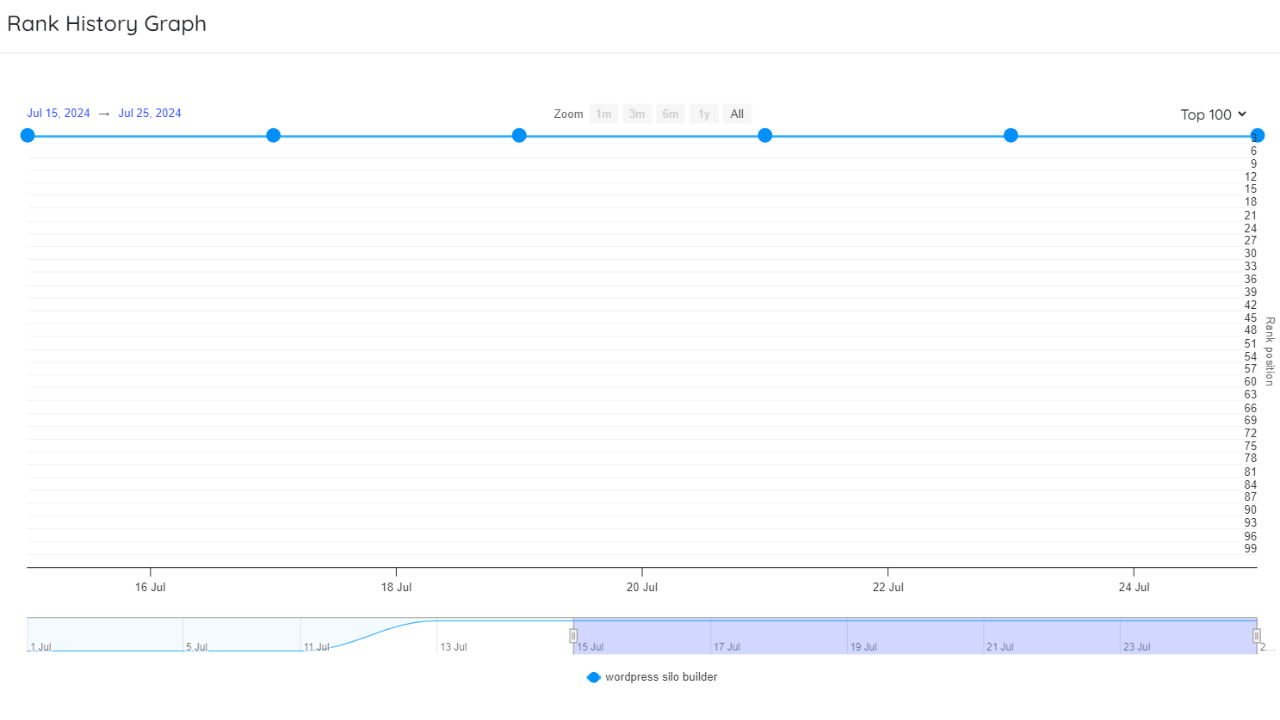
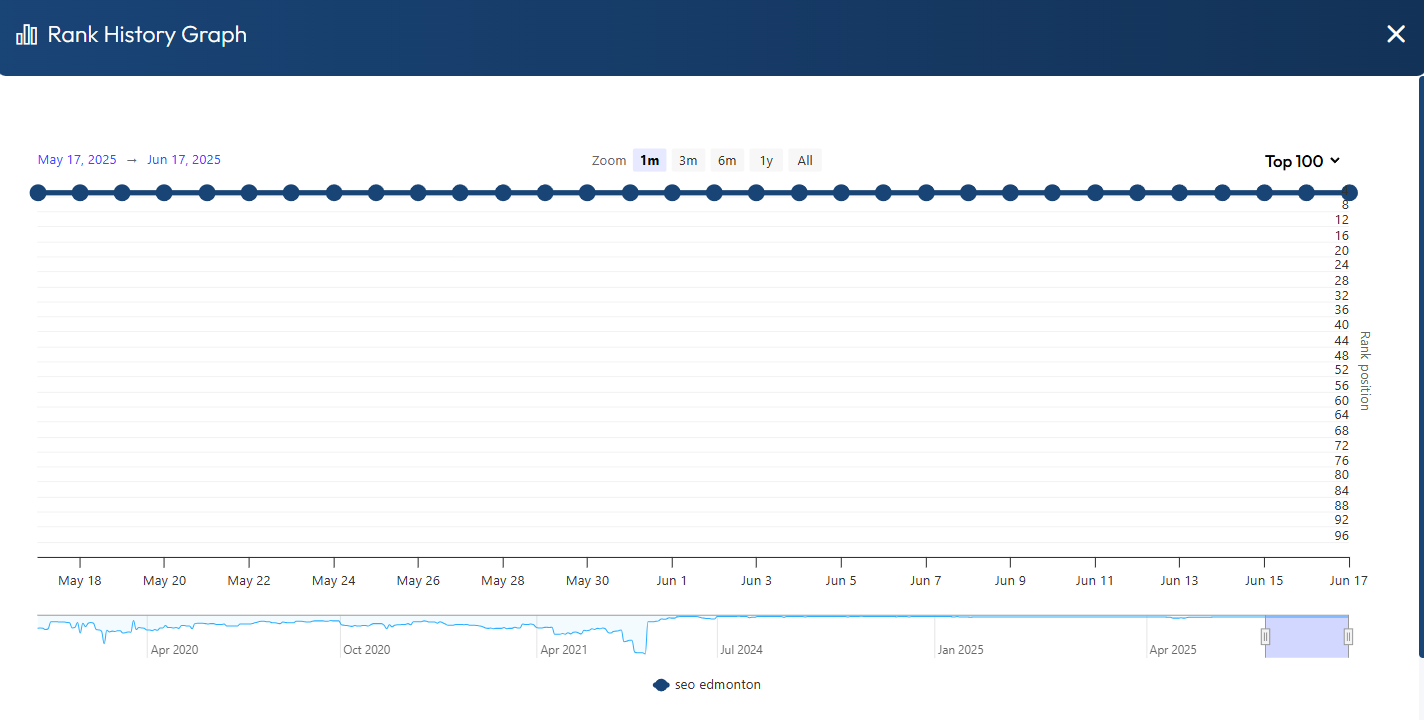
With Xagio, you can easily select the keywords you want to track in your project dashboard and then view your data in the Rank Tracker.
This is a completely automated feature, which includes graphs that you can easily share with clients as part of your monthly reporting.
More on reporting shortly.
8. Website Monitoring & Maintenance
Rankings don’t just depend on your content and optimizations. They also depend on having a healthy, reliable website underneath it all.
A site that loads slowly, goes down, or runs outdated software will struggle in the search results no matter how good its SEO is.
The trouble is that maintenance scales badly.
Keeping one website healthy is manageable. But once you’re running a portfolio of sites, for clients or your own projects, the upkeep multiplies fast.
Every site needs regular attention: logging in to check for plugin and theme updates, applying those updates without breaking anything, adding new plugins for new features, and keeping an eye on uptime.
Done the manual way, that means logging in and out of site after site, repeating the same checks across each one, which can swallow hours every single week.
Xagio has an insanely effective tool for website maintenance and monitoring, which allows you to select updates for multiple sites and update them remotely.
You can also easily upload and activate new plugins to multiple sites from one single dashboard, saving you tons of repetitive work.
And you have a convenient view of website uptime and any issues encountered that could all impact Google search rankings.
9. Client Reporting
If you offer SEO services to clients, reporting is the task that keeps those relationships healthy, and it’s easy to underestimate how much time it eats.
Clients want to see that their investment is paying off.
That means regularly pulling together rankings, traffic, and progress into something clear enough for a non-technical business owner to understand at a glance.
Done manually, that’s a recurring monthly chore of exporting data, building charts, and assembling reports for every client on your books.
There’s also a balance to strike that most reporting gets wrong.
Many SEO tools offer reporting dashboards, but in my experience they’re often too confusing and far too elaborate, burying the few numbers a client actually cares about under a mountain of metrics they don’t.
What clients really want to know is simple: are my rankings improving, and is my traffic growing?
That’s why I’ve simplified reporting within Xagio so that you can share SEO campaigns with the click of a button. You can share project dashboards that show keyword clusters, pages, and some technical SEO information, as well as rank tracking reports.
The best part is that these reports automatically refresh as you make changes and new ranking data becomes available. Essentially, you can tell your clients to come to the shared reports any time they want to see information about the overall progress.
You even have the option to white-label these reports for an even more professional look.
Benefits of SEO Automation
So, we’ve covered the main tasks you should consider automating, and now I want to show you what you can expect to gain when you automate more of your SEO campaigns.
Time Savings
One of the biggest benefits you’ll immediately see when automating SEO tasks is that you suddenly have a lot more time available.
It wouldn’t be uncommon for a new SEO project to take several weeks or even months to implement.
Now, imagine a project for a site with 30+ pages being done in just a few hours.
That is extra time you can use to refine your projects and strategies or to take on more clients and projects.
Money Saving
One of the problems I always had with the SEO tool industry was that you needed multiple different subscriptions to cover the whole process.
At one stage, I think I was spending over $500 per month on tools, and I still was doing all the hard work to put all the pieces together.
Xagio is different; it’s an AI-powered SEO tool that looks after everything, including niche selection, keyword research, keyword clustering, content writing, schema, and so much more.
It’s one tool with one subscription that saves you a ton of money.
Consistent Results
Another major challenge, even for the best SEO experts, is achieving consistent results.
When you’re reliant on a lot of manual processing, especially with a team of people, human error often comes into play.
With an automated SEO tool, that inconsistency is removed, and you gain a process that delivers predictable results.
That’s a critical benefit for any type of business.
Faster Implementation
I already mentioned that you save a ton of time by automating SEO tasks, but there’s another huge benefit associated with this.
See, when you complete your SEO project work in a day rather than many weeks, search engines pick up those updates a lot sooner. And the sooner they pick up the optimizations, the quicker you’ll see ranking results and improved traffic.
The end result is that you’ll drive up website revenue a lot sooner than if you had to wait for weeks or months to complete all the above tasks.
Scalable Processes
One of your goals as a digital marketer should be to develop an SEO strategy process that is repeatable and scalable.
Without automation, that means having a well-documented process that you can build a team around so that you can take on more projects at the same time.
However, AI automation tasks completely revolutionize scalability by freeing up huge amounts of time.
Whether you work as a solopreneur or have a team of VAs helping you, if you can complete project work in less than a tenth of the time, you can take on many more projects each month.
Data-Driven Decision Making
Your best SEO efforts will come to light when you make plans and decisions based on data rather than guesswork.
And when your SEO platform consistently lays out all the data you need to make decisions, then you’ll achieve far better results that you can repeat with each new project.
The major upside of this is that you’ll grow a lot more confident in your process and decision-making thanks to having a reliable SEO platform that gathers and calculates all the data you need for a successful project outcome.
Try The Leading AI-Powered SEO Software
SEO has traditionally been a hugely time-consuming process, but it doesn’t have to be that way. The tricky part is finding the right AI tools while not ending up with a fragmented process where you still have to manually handle all the data and information.
The solution is actually quite simple.
Try using Xagio for your next SEO project and see how quickly you’ll save many days of manual work.
It’s by far the best automated SEO software available, and you’ll be able to kiss goodbye to most of your other subscription tools.
Getting started with Xagio is as easy as installing a new WordPress plugin, and this could be the best decision you can make for your business success.