
Exact match domains have been declared dead more times than I can count, usually by people who have never actually tested one.
I have. Over and over, across more than 15 years of building rank and rent sites, and the results keep telling the same story.
EMDs still work today, and in local niches they remain one of the fastest ranking shortcuts available, as long as you follow two simple rules.
In this post, I’ll show you what those rules are, what Google has actually said about exact match domains, and the exact process I use to find untapped EMD opportunities before anyone else spots them.
By the end, you’ll know how to identify a winnable niche, confirm the domain is available, and judge whether it’s worth building on, all in a matter of minutes.
What Is An Exact Match Domain (EMD)?
An exact match domain is a domain name that is a 100% match with a specific search keyword. Some people also refer to it as a keyword domain, and typically SEOs look for .com, .net, or .org exact match domains.
Here’s an example.
Hundreds of people search for the term “mold removal Chicago” on a monthly basis, and an exact match domain would be moldremovalchicago.com, but it could also be the .net or .org version.
Since we already know that having a focus keyword in the URL is very advantageous for SEO purposes (e.g., domain.com/mold-removal-chicago/), it should then be obvious that having the keyword as the root domain instead of a URL slug is even better: moldremovalchicago.com
In fact, there was a time when simply having an EMD with a load of random keyword stuffing on the site was enough for search engines to catapult you to the top of the SERPs.
While those days are long gone, it’s still safe to say that there is value for search engine optimization.
I’ll provide some examples shortly.
You may also have heard of a “partial match domain” (PMD) that is supposedly a safer approach.
Let’s revisit my above KW example: “mold removal Chicago”. A PMD example would be moldexpertschicago.com, where not every word of the search term is represented in the domain.
These can still be valuable, but my testing has shown that there’s no real risk with exact match domains if you take the right approach.
Do EMDs Still Help Search Engine Optimization?
Yes, exact match domains still help you achieve higher search rankings, with all else equal.
Here’s what I mean.
Let’s say you started a Rank & Rent/LeadGen website to target the KW “mold removal chicago” and registered a new branded domain (e.g., themolddude.com) and an exact match domain (e.g., moldremovalchicago.com).
You then make the exact same on-page optimizations on booth sites, and you send very similar quality backlinks to them.
If an exact match domain had no influence on search rankings, then both sides should slowly appear in the same place in the SERPs.
Does that happen?
No, not in my experience. I have tested this on several occasions, and the EMD always ranks faster.
I have also created dozens of Rank & Rent sites with an exact match domain name, and more often than not, the sites appear in search rankings with little more than adding content and good on-page SEO. I’m not saying they hit #1, but they do index strongly & quickly.
The same happens when I test exact and partial match domains.
I’m pretty sure you have one nagging question.
Why Do People Believe Google Punishes EMDs?
Mostly because they believe what they hear and read rather than actually testing it for themselves. People LOVE to share this kind of stuff, and even worse, many LOVE to believe it simply because someone wrote about it.
Search engines like Google regularly refine their algorithms, and in many cases, those updates target specific techniques used by the SEO industry.
Exact match domains have been the target numerous times, and the most notable one happened in 2012.
Each time, there was a big shakeup in the search engine results pages, and people immediately concluded that this one tactic was the reason.
But can these people also clearly prove that there was only one issue with exact match domain sites?
Let’s take a closer look at what Google has to say.
What Does Google Say About EMDs?
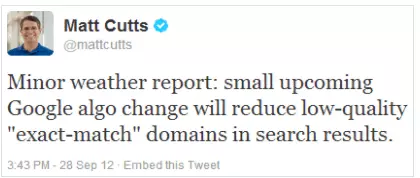
Google introduced an algorithm update in September 2012 that specifically targeted exact match domains.
Google’s Matt Cutts announced the following on Twitter/X:
Here’s the thing, though.
People only focused on the fact that he mentioned “exact match domains” and completely ignored the important “low-quality” part.
Even before 2012 and the clampdown on exact match domain sites, search engines had realized that many SEOs were spamming the Internet with crappy and KW-stuffed content.
As Matt states, this was simply an update that specifically looked at the exact match domain and low-quality content combination that was rampant.
But that doesn’t mean exact match domain SEO is dead.
Far from it, and I have a few simple rules for you to follow.
Simple Rules To Avoid EMD Penalties
If you look at any search result for local and Rank & Rent SEO, you’ll notice that the search results are still full of exact match domain sites.
Over the years, I have spent a lot of time analyzing these sites, and I’ve found that those that still appear in the search results follow two simple rules.
1. Avoid KW Stuffed EMDs
One reason so many exact match domains got affected in 2012 is that they had gone completely overboard. They either tried to stuff multiple keywords into one domain or they used keywords with four or more words in them to create an EMD.
There’s also the case of trying to create EMDs with keywords that simply wouldn’t make sense as a website or business name.
Let me explain.
Here are two KW examples that would NOT make a good exact match domain project:
- homeowners insurance miami dade county
- movers nyc to miami
Both of these KWs have good search volume, but what kind of business would be called “Movers NYC To Miami”?
Exactly, it’s a highly unlikely business name and stinks of KW stuffing!!!
If you’ve got a short keyword phrase and it makes sense to be the name of a business, then it should be fine as long as you’re careful with your content.
This leads me to the second point.
2. Create Valuable Information
The days when you only needed an exact match domain and really crappy, keyword-stuffed content are long gone.
As highlighted above in Matt Cutts’ tweet, Google specifically looks at the quality of the content as well.
That means one of two things.
Either you hire great writers to create unique content, or you use AI to create it for you.
The important thing is that you need to make sure the content is valuable and provides information that will help readers.
If you do that, then exact match domains are going to be hugely helpful for your SEO goals.
The big question now is how you find exact match domains quickly and consistently, and Xagio has an answer for that as well.
My Process For Finding EMDs
Years ago, I got so tired of manually digging through keyword lists and registrar searches that I had my team build a tool for it. You might remember it as Niche Hunter.
That tool has since evolved into KillerEMD, and it has turned a process that took me entire weekends into something I now do over a coffee.
Here are the four steps I follow to find golden nugget niches.
1. Set Your Search Variables
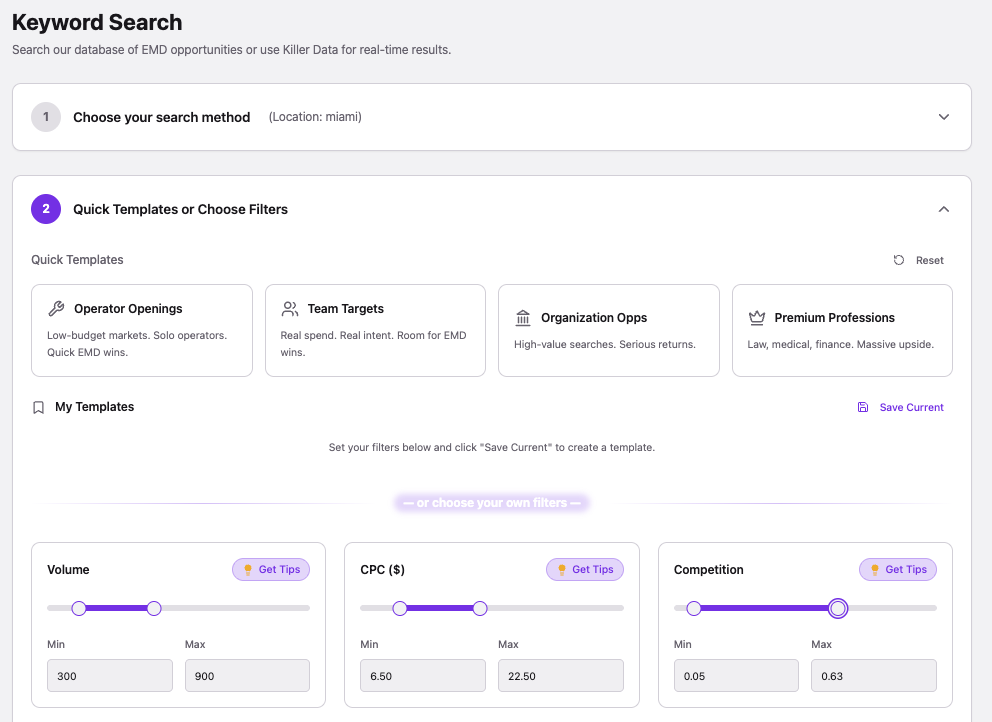
Every search in KillerEMD starts with three filters:
- monthly search volume
- cost-per-click
- advertiser competition
These three numbers control what kind of opportunities come back.
My advice for your first searches is to keep the volume range modest and set a meaningful CPC floor, because a keyword that advertisers pay real money for is a keyword that generates real leads.
Resist the urge to chase big volume numbers. A local keyword with a few hundred searches a month and strong commercial intent will make you more money than a high-volume term you can never crack.
2. Search By Niche Or By City
This is where you decide how to attack the research, and there are two ways in.
If you already know your industry, enter the niche and let KillerEMD surface the cities where that service has demand. This works well when you have experience in a vertical and want to replicate it in new locations.
If you’d rather work the other way around, enter a city and discover which industries there have search demand worth targeting. I use this approach when I want to build a cluster of sites in one metro area I can service together.
Neither approach is wrong. The keyword-first route builds on what you know, while the city-first route uncovers niches you would never have thought to check.
3. Review The Results And Check The Kill Score
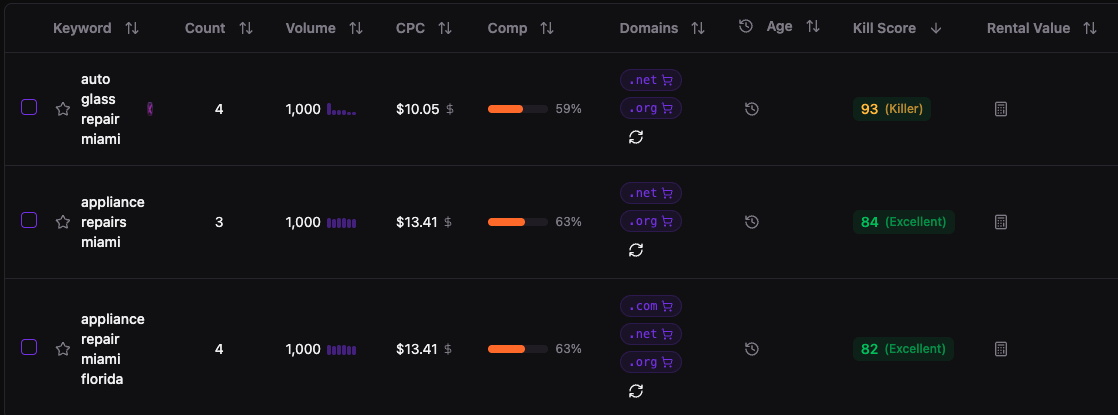
Your search returns a list of keywords with their volume, CPC, and competition data, but the column that matters most is the Kill Score.
The Kill Score condenses everything I used to check by hand into a single number. It examines how many top-ranking pages carry the keyword in their title and URL, how much of the SERP is taken up by ads, whether directories and weak pages are holding positions, and what the backlink picture looks like.
A high score means the front page is soft and an EMD has a genuine shot at breaking in quickly. A low score tells you to move on before you’ve wasted a cent.
This single feature replaces the slowest part of the old manual process, where every promising keyword meant five minutes of squinting at search results.
4. Register The Exact Match Domain
The final step used to mean copying keywords into a registrar one at a time, only to find the good ones were taken years ago.
KillerEMD checks availability for the .com, .net, and .org versions of your exact match domain right inside the results, so you know instantly whether the opportunity is real.
You can even add other TLDs to check for your specific country.
When you find a keyword with a strong Kill Score and an available domain, register it then and there. Good EMDs in proven niches do not stay available for long, and hesitation is how you end up watching someone else rank with the domain you found first.
Find Your First Killer EMD Today
Exact match domains never stopped working. What stopped was people doing the research properly, and that’s exactly the gap you can now step into.
You know the two rules: skip the keyword-stuffed monstrosities and build something genuinely valuable on the domain. You know the process: filter, search, check the Kill Score, and register before someone else does.
The only thing left is to run your first search.
KillerEMD has a free version, so you can find your first exact match domain opportunity today without spending a cent.
Sign up, run a search on a city or niche you know, and see what untapped EMDs are sitting there waiting. The next one someone registers could be yours.