
Most people pick keywords like they’re buying lottery tickets: a “green” difficulty score, a little search volume, and a hope-and-pray on-page SEO strategy.
There’s a better way, and it’s surprisingly simple with the right knowledge and insights.
When you know how to read a SERP, you can spot the “easy wins” hiding in plain sight and build a simple plan around them.
That’s especially powerful when you’re pairing the right keyword with the right EMD, because you’re stacking relevance and clarity from the very start.
In this guide, we’ll walk through a practical SERP Opportunity Analysis process: how to identify soft targets, check visibility (pixel depth), match search intent, and choose the right moment to enter.
And I’ll show you a tool that automates the process so that you can find highly profitable business opportunities in seconds.
Why Keyword Difficulty Scores Mislead You
Keyword Difficulty scores feel like a shortcut, but for local SEO, lead gen, and EMD sites, they’re often pointing you in the wrong direction.
Here’s what I mean.
Most KD formulas are built to measure authority: how strong the ranking domains are, how many backlinks the top pages have, and how “trusted” those sites look in aggregate.
That’s a clean number for a dashboard, but it’s not the same thing as real-world difficulty.
In local SERPs especially, Google frequently ranks pages that aren’t designed to win the query. You’ll see directories, abandoned social profiles, directory sites, or forum threads that happen to mention the term.
The result?
A traditional KD tool looks at those high-DR domains and concludes the SERP is “very hard,” even though the pages themselves are thin, outdated, and poorly aligned with what the searcher wants.
More often than not, there are multiple EMD or PMD sites with no backlinks but great on-page SEO, mixed into the top 5 positions.
That’s why I treat KD as background noise and the SERP as the truth.
If Google is ranking directories and dead pages, it’s not telling you ‘this keyword is hard’; it’s telling you ‘I need a better result.’
And for EMD-driven lead gen, that’s exactly how you find keywords where a simple, well-structured site can win quickly.
Soft Targets: The Fastest Signal Of Winnable SERPs
Soft Targets are the fastest “tell” that a SERP is winnable, especially in local SEO, lead gen, and EMD-driven sites.
A Soft Target is a high-authority result that ranks by default, not by design.
It’s there because it has enough domain strength to show up, but the page itself doesn’t properly answer the query.
You’ll spot them instantly: generic directory listings, abandoned Facebook pages, aggregator pages that force sign-ups, or a random Reddit thread ranking for a service keyword.
Even sites like Yelp and Craigslist are often only there because of domain authority.
Here’s the thing, though.
You can outperform authority with great KW research and solid on-page optimization, two things all these high-authority sites completely lack.
A simple rule: the more Soft Targets you see in the top 10, the easier it is to break in.
If half the first page is “placeholders,” you don’t need to out-muscle the SERP; you just need to out-focus it with a page built to win that exact search.
Pixel Depth: When “Rank #1” Still Gets Few Clicks
Pixel depth is the reason “Rank #1” can still feel like you’re invisible.
Modern SERPs stack so many features above the organic results that the first “real” listing might start way below the fold.
It can be even worse on mobile devices.
Between ads, Gemini AI answers, map results, and People Also Ask, your #1 organic spot can end up living in what you might call Scroll Country: population: nobody.
That’s why pixel depth matters.
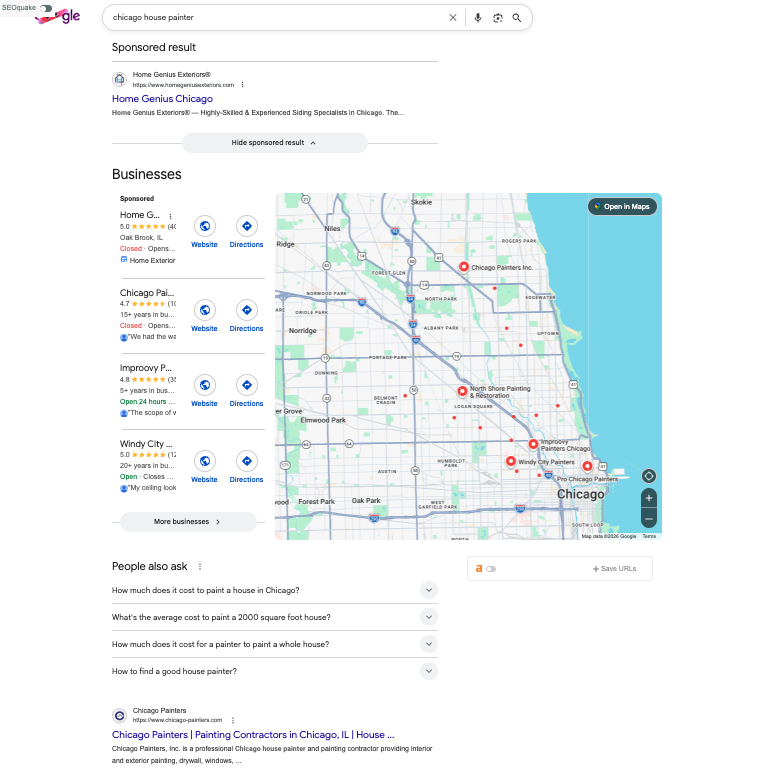
It measures how far a user has to scroll before they even see your link. If the first organic result sits below the first screen, your click-through rate drops fast, even if you technically “won” the ranking.
So before you chase volume, check visibility. If a keyword is feature-heavy and organic listings are buried, it can be fool’s gold: the search demand is real, but the organic clicks are scarce.
In those cases, choose a cleaner SERP, or adjust your strategy to the feature that’s dominating.
Intent Matching: The Shortcut To Beating Confused SERPs
Intent matching is the shortcut because Google doesn’t rank “the best page,” it ranks the best match for what the searcher is trying to do.
When the SERP is confused (showing the wrong types of pages for the query), you’ve found an opening.
Start by sorting intent into four buckets:
- Buy now (transactional)
- Compare options (commercial investigation)
- Learn something (informational)
- Reach a specific brand (navigational)
Then look at what’s ranking. If you search a service term and see Reddit threads, thin directories, or generic national pages, it usually means Google can’t find a strong, purpose-built local result.
That’s not a dead end; it’s a clear signal.
The play is simple: identify the real goal behind the search, create the page format that satisfies it, and make the structure obvious.
Transactional queries want fast service pages with clear CTAs and trust signals.
Comparison queries want lists, pros and cons, and decision helpers.
Informational queries want step-by-step answers. When you align format with intent, you don’t just rank, you also convert, sending an even more powerful signal to Google, that your site is satisfying SERP users.
Competitor Weakness Detection: Find Cracks, Not “DR Scores”
Competitor weakness detection is where SERP Opportunity Analysis becomes practical.
Instead of staring at DR scores and assuming you’re outgunned, you look for the specific reasons the current results are ranking.
In local SEO and lead gen, you’ll often find pages “winning by default,” like:
- Thin service pages
- Vague homepages
- Listings that barely address the query
What you need to do is run a quick “weakness scan” on page one and ask these questions:
- Title Tag + Meta Description: Are they generic, missing the primary keyword, or written like boilerplate instead of a clear promise?
- H1 And Page Structure: Is the H1 vague, duplicated, or misaligned with the query, and are headings organized in a way that makes the page easy to scan?
- Content Depth And Freshness: Is the content thin, outdated, or poorly structured compared to what the searcher likely wants?
- Trust Signals And Conversion Clarity: Are they missing reviews, photos, guarantees, pricing cues, strong CTAs, or a clearly stated service area?
- Local Signals + Schema: Is the address hidden, NAP inconsistent, service area unclear, or schema missing/sloppy (LocalBusiness, FAQ, Product/Service where relevant)?
Also watch for “zombie sites”: high-authority domains that haven’t been updated in years, have broken forms, slow pages, or dead imagery.
These results are fragile.
You don’t have to be bigger; you just have to be better where it matters.
But you don’t have to spend months learning this skill and endless days trying to find those golden nuggets in the keyword pile.
There is a better way.
How KillerEMD Automates The Process

KillerEMD is built specifically for this workflow, combining keyword discovery, Kill Score filtering, SERP validation, domain availability, and AI-assisted profitability research into a single process.
Step 1: Set Your Search Parameters
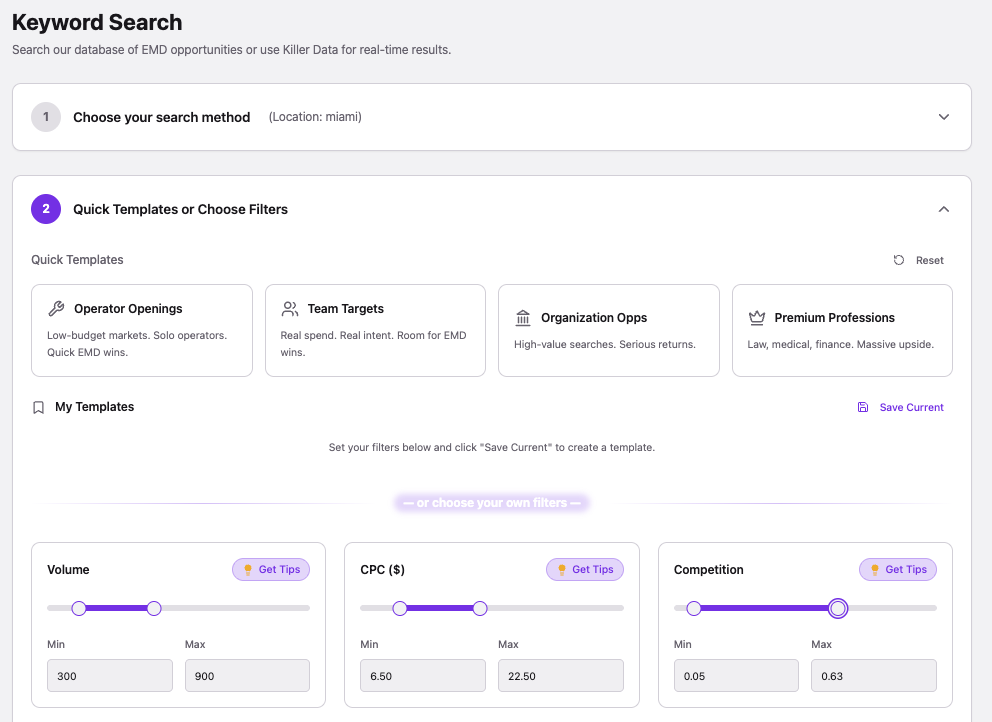
Start by entering either a location or a niche, then define your search variables for volume, cost-per-click, and advertiser competition.
These filters are where you set the difficulty ceiling for your results. Lower thresholds return easier-to-rank opportunities, while raising them opens up more competitive niches for experienced builders.
Step 2: Review Your Keyword List
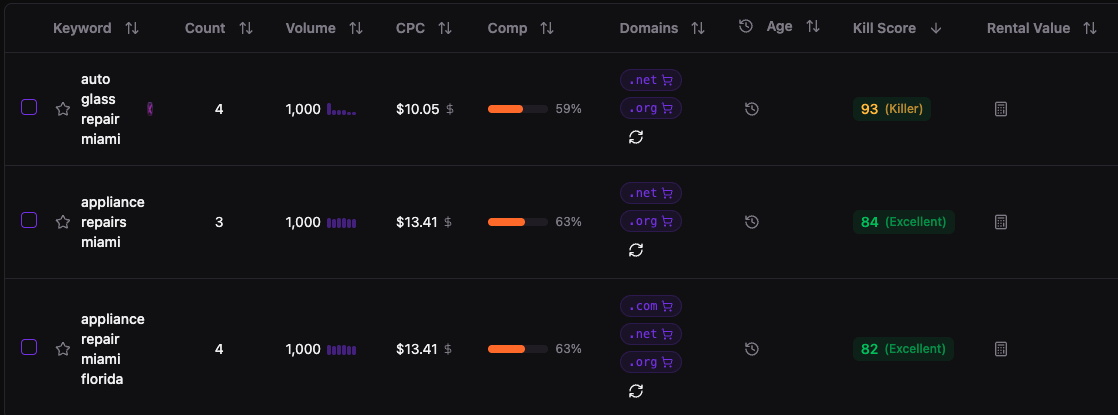
Within seconds, KillerEMD returns a list of local search keywords that match your parameters, each showing search volume, CPC, and ad competition data.
At this stage you are scanning for keywords that look like realistic business names, filtering out anything that is too generic, too long, or too niche-specific to make sense as an EMD.
Step 3: Check the Kill Score
For any keyword that looks promising, you can get KillerEMD to calculate its Kill Score.
The Kill Score automates the manual SERP checks that would otherwise take five minutes per keyword: it looks at whether the keyword appears in the titles and URLs of the top results, assesses how much of the page is occupied by ads, identifies directory listings and weak pages, and checks backlink signals.
The higher the Kill Score, the easier the opportunity is to break into.
When you are scanning dozens or hundreds of keywords, this is where the real time saving happens. What used to take days of repetitive manual checks now takes seconds.
Step 4: Confirm Domain Availability Instantly
Once a keyword clears the Kill Score, KillerEMD checks whether the exact match domain is available across .com, .net, and .org in the same workflow.
There is no switching between tabs, no heading to a registrar to discover the domain was registered in 2019. You get the availability data right alongside the keyword data, so you can make the call immediately and keep moving.
Step 5: Assess Profitability With The AI Assistant
A winnable SERP with an available domain is only part of the picture. The other part is whether the niche is actually worth building a site for.
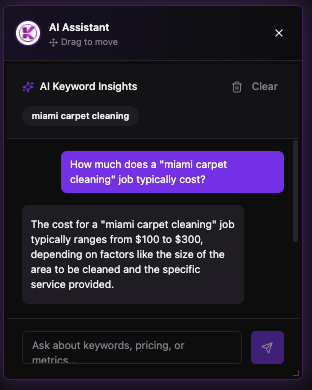
KillerEMD includes an AI assistant that lets you ask profitability questions directly inside the tool.
How much does an average job in this service niche cost? How much is a lead worth to a business in this city? What do backlink profiles look like for the top-ranking pages?
These are the questions that separate a golden nugget from a keyword that looks good on paper but leads nowhere commercially.
Find Your First EMD Business For Free
Stop making keyword decisions based on “green” KD scores and start using the SERP as your source of truth. When you look for Soft Targets, measure pixel depth, match intent, and run a quick vulnerability audit, you’ll spot the exact searches where a focused page can break in fast.
That process turns keyword research into a repeatable decision system, and you can now fully automate finding highly profitable EMDs.
KillerEMD is built for this workflow. It helps you uncover real, winnable KWs, connect them to EMD opportunities, and move from “idea” to “build” with confidence and speed.
Register for a free KillerEMD account and find your first EMD business for free.