
Expired EMDs sound like the shortcut everyone wants: instant age, built-in trust, and maybe a head start in the rankings.
Fresh EMDs sound boring by comparison, but they’re often the safer, faster path to a clean win.
The real difference isn’t “old vs new,” it’s history vs clarity, and most people buy domains without checking what they’re inheriting.
In this guide, we’ll break down when expired domains are worth the risk, when fresh domains outperform them, and the exact checks that separate a hidden gem from a poisoned asset.
And I’ll introduce you to a tool that makes life so much easier.
Let’s dive straight in.
What “Fresh” And “Expired” Really Mean

A fresh EMD is exactly what it sounds like: a brand-new domain registration with no past life. No backlinks, no baggage, no surprises.
It’s a clean slate, which is great when you’re building a local lead gen site and you want Google to understand one clear topic, in one clear location, from day one.
An expired EMD is a domain that used to belong to someone else, lapsed, and is now available again.
Sometimes an older domain with real links and genuine history is a true gift.
Other times it’s like grabbing a “mystery box” off a bargain shelf: the label looks promising, but you won’t know if it’s treasure or junk until you check what’s inside.
That’s the key point: expired doesn’t automatically mean “better.” It just means pre-owned.
And in SEO, “pre-owned” can mean anything from “trusted asset” to “why does this domain have 400 backlinks from foreign coupon sites?”
Why Fresh EMDs Usually Win For Local Lead Gen
Fresh EMDs usually win for local lead gen because they let you build relevance without fighting history.
When a domain is brand new, Google doesn’t have to “unlearn” anything.
You control the topic, the location signals, the internal structure, and the on-page messaging from the first crawl, which makes it easier to create a clean, consistent footprint.
Fresh domains also eliminate the biggest expired-domain risk: inherited baggage.
A domain can look great in a marketplace and still carry spammy backlinks, weird redirects, thin content history, or a past topic that has nothing to do with your niche.
In local lead gen, that kind of noise can slow you down or force you into hours of cleanup before you even publish.
And even if you get everything right, it’s still a significant risk.
Most importantly, local SERPs reward focused relevance and intent match.
If you pair a fresh EMD with a tight service-area page set, clear calls-to-action, and strong trust signals, you’re often competing against directories and placeholders, not perfect competitors.
In that environment, clean beats “aged” more often than people expect.
When An Expired EMD Is Actually Worth It
An expired EMD is actually worth it when the history gives you a real advantage, not just the illusion of one.
The best cases are domains that were previously used for something closely related to your niche, have a clean backlink profile, and show signs of being a legitimate business or resource site, not a churn-and-burn SEO experiment that changed topics every six months.
Think of a local business website that was an EMD or PMD that went out of business; if the site didn’t have dodgy SEO done and instead got realistic citations and local backlinks to pages with real content, then an expired EMD can be a diamond in the rough.
That kind of continuity can give you a real head start, because you’re inheriting useful trust signals instead of starting from zero and whispering, “Please trust me, Google.”
The key is that you’re buying quality and relevance, not just age. A ten-year-old domain with junk links and random history is not an “asset”.
It’s a cleanup project in disguise, and it takes a whole other skill and commitment level to do a full SEO cleanup.
A Simple Decision Framework (Fresh Vs Expired In 60 Seconds)
Use a simple rule for fast decisions: check history first, then check backlinks.
Start with the Wayback Machine and see if the domain actually has a past. If there’s no meaningful history, treat it like a fresh domain.
It’ll give you a clean opportunity for great and fast rankings, knowing that there isn’t any dodgy baggage to deal with.
If there is history, your next question is simple: did it ever look like a real site, or did the site cover the three deadly P’s: poker, pills, and porn?
But even if the archived content doesn’t look dodgy, you’ll have to address a few more questions:
- Are there spammy-looking link farm pages?
- Are there weird topic changes that don’t match the domain URL?
- Was there a load of foreign language spam on the site?
- Was the content extremely low-quality spun junk?
If the history looks messy, skip it. There are always more domains and better opportunities waiting to be found.
And I’ll show you shortly how to find them on an industrial scale.
If the history looks clean and relevant, then it’s worth doing the harder check: backlinks. Use tools like Moz, SEMrush, or Ahrefs to review link quality, anchor text, and topical relevance.
This part takes more time and manual review, but it’s where you confirm whether the domain is a genuine opportunity or just a good-looking trap.
One last thing I would say, though, is that even a clean expired EMD with decent backlinks doesn’t guarantee faster rankings.
I’ve registered expired domains and seen them jump to #3 in the SERPs within days.
But I’ve also had some that didn’t rank any faster than a completely fresh EMD.
Where I think you have more opportunity is in automating a lot of the research with my free software, KillerEMD.
Let me show you what it’s about.
How KillerEMD Helps You Vet Available EMDs

I built KillerEMD to make it easier and faster to find highly profitable business opportunities and included these automation features.
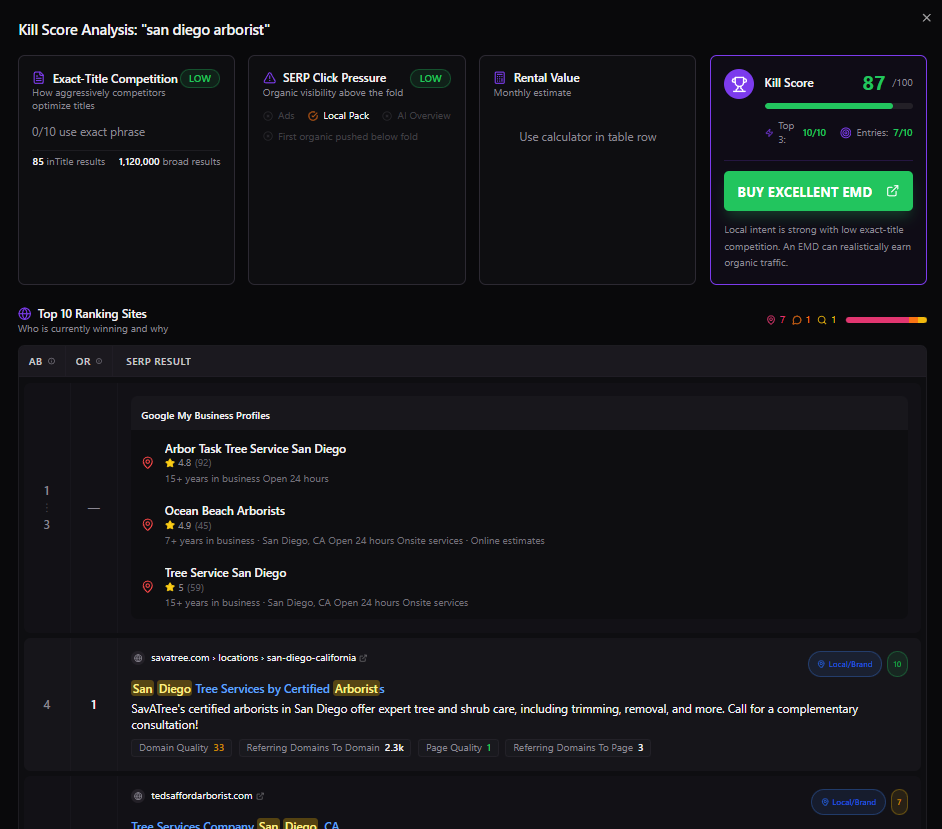
Kill Score: Filter For Real Opportunities First
KillerEMD helps you vet available EMDs by starting with the question that matters most: Is this keyword and SERP even worth your time?
Its Kill Score is built to show opportunities based on real-world SERP conditions (including weak competitors and soft targets), so you can stop wasting time on “looks good in theory” keywords.
Domain Availability: Check Before You Chase
Once you spot a strong opportunity, KillerEMD helps you check whether the matching EMD is actually available, which saves you from falling in love with a domain someone else registered in 2017.
That means you can move from idea to decision quickly instead of doing manual SERP checks for domains you can’t even buy.
And you don’t have to switch between tabs to see if your target TLD (.com, .net, or any other) is available to register.
SERP Analysis: Validate The Opportunity
KillerEMD also helps you review the SERP itself, so you can confirm whether you’re looking at a genuine opening or just a keyword that looks exciting in a spreadsheet.
This is where you can sanity-check soft targets, relevance, and competition quality before spending time on Wayback Machine and backlink audits.
AI Assistant: Turn Data Into A Decision
The AI assistant helps you make sense of what you’re seeing, so the process feels less like detective work and more like a repeatable system.
In plain English, KillerEMD helps you narrow the field fast, so your history and backlink checks are spent on the best candidates, not every shiny object in the list.
Rental Value: Calculate How Much You Could Charge
I’ve also included a tool that lets you calculate how much you could charge a customer.
This is critical because targeting a niche that has very little per-sale profit for a client makes it difficult to become profitable.
With just a few input values about the average price of a job and profit margins, you’ll quickly get details about how much each phone call can be worth to a client.
Hint: You can use the AI Assistant to help you research the average price of jobs and profit margins for any niche and industry.
Start Using KillerEMD For Free
Fresh EMDs are usually the safest option because they give you a clean slate, clear topical relevance, and no hidden baggage to slow you down.
Expired EMDs can absolutely work, but only when the history is clean, the backlinks are relevant, and you’ve done the checks properly.
If you’re unsure, fresh is the better default, and you can still move fast by choosing stronger opportunities upfront.
KillerEMD helps you do exactly that by finding winnable SERPs, checking EMD availability, and narrowing your shortlist before you spend time on manual history and backlink audits.
It’s the fastest way to move from “interesting keyword” to a real domain decision with confidence.
Register for a free KillerEMD account and start finding better EMD opportunities today.