
When you can put link publish dates, indexation timelines, and ranking movement into context, you stop treating backlinks like a numbers game and start treating them like performance data.
A clear data association makes it much easier to spot what is moving rankings, what is wasting budget, and what deserves to be repeated.
However, most tools don’t combine all the data you need in one place, making strategic decisions more difficult.
In this guide, I’m going to break down what you should actually track, why most backlink tracking methods miss the important part, and how to make link effectiveness much easier to see.
Why Backlink Tracking Is About More Than Counting Links
Backlink tracking is about far more than counting how many links you built, because a backlink total on its own tells you almost nothing useful.
A list of 20 new links might look impressive in a spreadsheet, but it doesn’t tell you which links were indexed, which pages they pointed to, or whether any of them actually moved rankings.
This is where a lot of SEOs fool themselves.
They build a batch of links, wait a few weeks, see rankings go up, and then assume every link in that batch was a winner.
And I get it.
I used to have huge “vanity” spreadsheets, and I’d celebrate at the end of a week when the list of backlinks had grown.
Often, rankings do go up because you built a particularly strong backlink.
But if you don’t compare build date, index date, and ranking data, then you’ll never clearly know which links worked.
On the flip side, you might build two great links and one bad one; the result could be not much change to rankings.
But what if you could see the effect of the first two great links and then see that rankings dropped once the poor link was indexed?
That’s why it’s not a good idea to just create a list of backlinks without clear context.
Let me explain.
What You Should Actually Track For Every Backlink
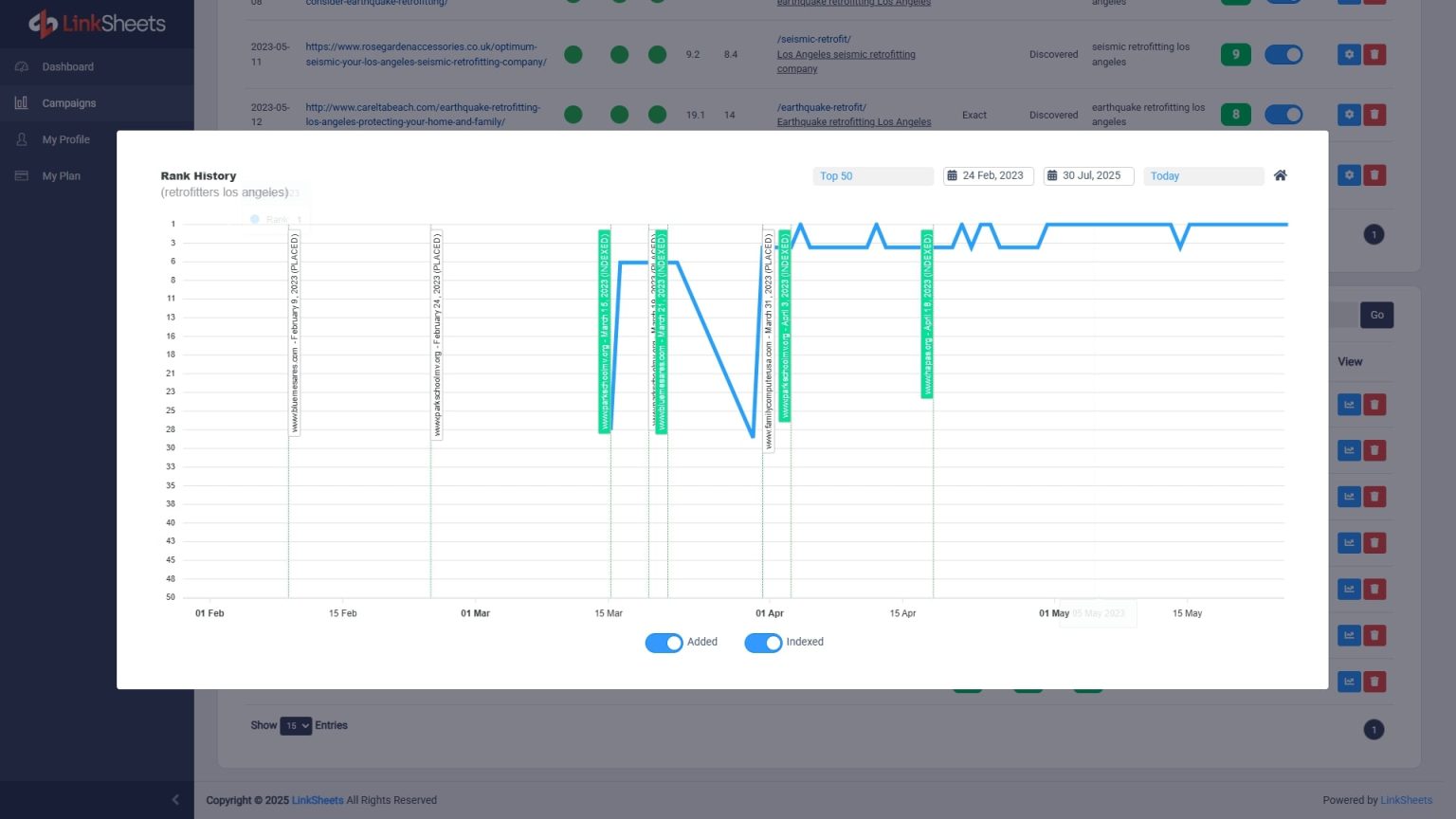
A backlink is only useful as data when you know more than just “it exists.”
If all you have is a URL in a spreadsheet, you still have no clear way to judge whether that link had any chance of influencing rankings.
To properly track backlinks, you should log:
- Link source URL: the exact page where the backlink lives, so you know what site and page type it came from.
- Target page: the page on your site receiving the link, because not every backlink points to the page you actually care about ranking.
- Anchor text: the clickable words used in the link, which helps you monitor relevance and avoid over-optimization.
- Publish date: when the link first went live, so you can compare it to ranking movement later.
- Indexation status: whether Google has actually indexed the linking page, because a published link that isn’t indexed may have little or no effect.
- Indexation date: when Google indexed the link, because it won’t have any impact until Google is aware of it.
- Link quality or authority signals: metrics or trust indicators that help you judge the likely strength of the backlink.
Without that extra context, you’re only tracking backlinks at a surface level.
You may know a link exists, but you still won’t know whether it had any real chance of influencing rankings or whether it was just another line item in a spreadsheet.
Why Most Backlink Tracking Methods Break Down
Most backlink-tracking methods break down because the information is spread across too many sources.
The links are in one spreadsheet, rankings are in a separate tool, indexation gets checked somewhere else, and notes about what changed often live in someone’s head or a Slack message from three weeks ago.
At first, that feels manageable.
Then the campaign grows, more links get built, rankings start moving, and the whole thing turns into a mess of tabs, color codes, and “I’m pretty sure that link went live around Tuesday.”
That’s where the real problem starts.
When you can’t see links, rankings, and timing together, you stop measuring and start narrating.
A page jumps, so you assume the last batch of links worked.
A page drops, so you blame the most recent guest post or PBN link.
But without a proper timeline, those conclusions are often little more than educated guesswork. This is exactly how SEO myths get created and passed around.
Someone builds links, rankings move, and a story gets attached to it without enough evidence.
However, good backlink tracking should reduce confusion, not create more of it. If the system makes it hard to connect cause and effect, it’s only helping you record activity, not understand results.
The Missing Piece: Tracking Backlinks Against Ranking Movement
The real value in backlink tracking comes from being able to line up link activity with what happened in the SERP afterward.
If a link was published on May 1, indexed on May 12, and the target page started climbing on May 15, that gives you something concrete to analyze.
Here’s a different scenario.
If rankings dropped before the link was indexed, then the link probably wasn’t the cause.
If rankings moved across several pages at once, the cause may have been a broader update or a sitewide change instead.
This is why backlink tracking becomes much more useful when you stop looking at links as isolated events and start looking at them as part of a sequence.
That sequence is what helps you separate real impact from coincidence.
What To Look For When Measuring Backlink Effectiveness
Once you have backlinks and rankings on the same timeline, the next step is knowing what signs actually matter.
The first thing to check is whether rankings moved after the link was published, because if nothing changed at all, the link may have had little or no impact.
Then look at whether the movement happened only after the link was indexed, because that usually gives you a much stronger clue that the backlink was actually able to influence the page.
You should also watch for pages breaking out of a stuck range.
If a keyword has been hovering between positions 12 and 20 for weeks and then starts climbing after a relevant link indexes, that is a much more meaningful signal than a random one-day jump.
It also helps to check whether impressions, clicks, and position stability improved, because effectiveness is not just about a brief spike.
Sometimes the best links are the ones that make rankings hold, not just jump.
And sometimes the most useful insight is that nothing happened.
That tells you just as much as a ranking increase, because it helps you identify link types that look good on paper but don’t actually move the needle.
Why Indexation Matters More Than Most People Realize
One of the biggest blind spots in backlink tracking is forgetting that a published link and an indexed link are not the same thing.
A backlink can be live on the page, visible to you, and still have little to no SEO value if Google has not indexed that page yet.
That means the ranking impact can be delayed, muted, or never happen at all.
A lot of SEOs log the publish date, then watch rankings, and assume the link “did nothing” when in reality, Google may not even have counted it yet.
That’s why indexation matters so much.
If you don’t track it, you’re leaving out one of the most important pieces of the puzzle.
How LinkSheets Makes Backlink Tracking Much Easier

Once you’re trying to monitor publish dates, indexation, ranking movement, anchor text, and link quality all at once, the manual approach starts getting messy very quickly.
At that point, backlink tracking usually turns into a mix of spreadsheets, browser tabs, rank trackers, and half-remembered notes about when a link was built or when a page started moving.
That’s where LinkSheets fits in.
It brings ranking history, backlink build dates, and indexation dates onto the same timeline, which makes it much easier to see whether a link actually lined up with a ranking change.
That matters because it helps you separate real impact from coincidence, especially when rankings are also being influenced by updates, content edits, or normal SERP volatility.
It also automates scheduled indexation checks and notifications, so you know when links finally get picked up by Google without having to keep checking them yourself.
On top of that, it includes Link Power scoring and anchor text profile calculation, which adds more context around backlink strength and link profile balance.
And because it supports visual reporting and clean graphs, it also makes sharing progress with clients or team members a lot easier than digging through spreadsheets.
Get Your Free LinkSheets Account Today
Tracking backlinks properly is not about collecting URLs in a spreadsheet; it’s about understanding when links go live, when they index, and whether they actually influence rankings.
Once you can line up backlink activity with ranking movement, link building becomes far easier to measure, repeat, and improve.
That’s what turns backlink tracking from admin work into a genuine SEO advantage.
Create your free LinkSheets account today and start tracking backlinks in a way that actually shows what’s working.
Use it to connect backlinks, indexation, and ranking movement in one place, so your SEO decisions are based on evidence, not assumptions.