
One question I always get on my webinars is for a step-by-step breakdown of how I refine my clustered keyword groups.
Because I’ve been doing SEO for over 15 years, I handle the keyword clustering and seeding almost on autopilot.
And I get that people have difficulty getting the same results I do.
So I’m going to walk you through exactly how I do it, and then show you how I’ve made the whole process even faster.
And the results blew even me away.
What Is Keyword Clustering?
Keyword clustering is the process of grouping related keywords together so that each group can be targeted by a single page.
Instead of building one page per keyword, you build one page per topic, and that page goes on to rank for every closely related term in the group.
Take a local plumbing business as an example. Terms like “emergency plumber,” “emergency plumbers,” and “emergency plumbing service” all describe the exact same need.
They don’t each need their own page. They belong in one cluster, targeted by a single, well-optimized page.
But “emergency plumber” and “water heater installation” are different.
One is an urgent call-out, the other is a planned, bigger-ticket job, so the buyer is in a completely different mindset. They belong in separate clusters, each targeted by its own page.
That distinction is the heart of clustering. You group keywords by how closely they match in phrasing and meaning, and just as importantly, by the intent behind them.
Get that grouping right and each page sends a clear, focused signal to Google about exactly what it covers.
Get it wrong and you run into keyword cannibalization, where two or more of your own pages target the same terms and end up competing against each other.
When that happens, Google isn’t sure which page to rank, so it often ranks none of them well, and you lose positions you should have won easily.
Why Does Keyword Clustering Matter?
I have been preaching this for a long time now: keyword research is the most important step in every SEO project, because it is the foundation of everything else you do.
Just like successfully building a house is dependent on having a rock-solid foundation.
The problem is that people often just determine a couple of keywords with decent search volume and then start building and optimizing pages.
That approach almost always leads to major problems down the line.
At the very least, you miss out on optimizing for multiple other keywords that could multiply your search traffic.
But it also often leads to a disorganized approach to content planning.
See, when you don’t cluster properly, you end up with pages that target too many or unrelated keywords at once.
Google then struggles to understand what each page is actually about, and pages with a muddled focus get demoted in favor of clearer, more focused competitors.
In both instances, Google and other search engines struggle to understand what your pages are about and therefore demote your site in the SERPs.
It’s a costly mistake that is difficult to undo.
But you can easily prevent it.
How Do I Manually Approach Keyword Clustering
Before any tool gets involved, clustering comes down to a series of judgment calls, and these are the same calls whether you do it by hand or automate it.
I start by looking at the full list of keywords as a whole, rather than diving straight into individual terms. I’m looking for the high-level topics that naturally emerge, the handful of themes that most of the keywords fall under.
Those themes become my starting groups.
Then I work through the keywords and assign each one to the group it fits best, based on both the wording and the intent behind the search.
This is where the real judgment comes in. Some keywords clearly belong together. Others could arguably sit in two different groups, and a few are distinct enough that they need a group of their own.
The goal at every step is the same: each group should be tight enough that a single page could satisfy everything in it.
Once the groups are set, I review them one more time, looking for keywords that would be better off split into their own group or merged with another.
That review step is what separates a rough grouping from a clean, rankable structure.
Inside Xagio, this entire process becomes a lot faster. After running my keyword research in Agent X or the Project Planner, I open the keyword cloud to get a feel for what I’m dealing with.
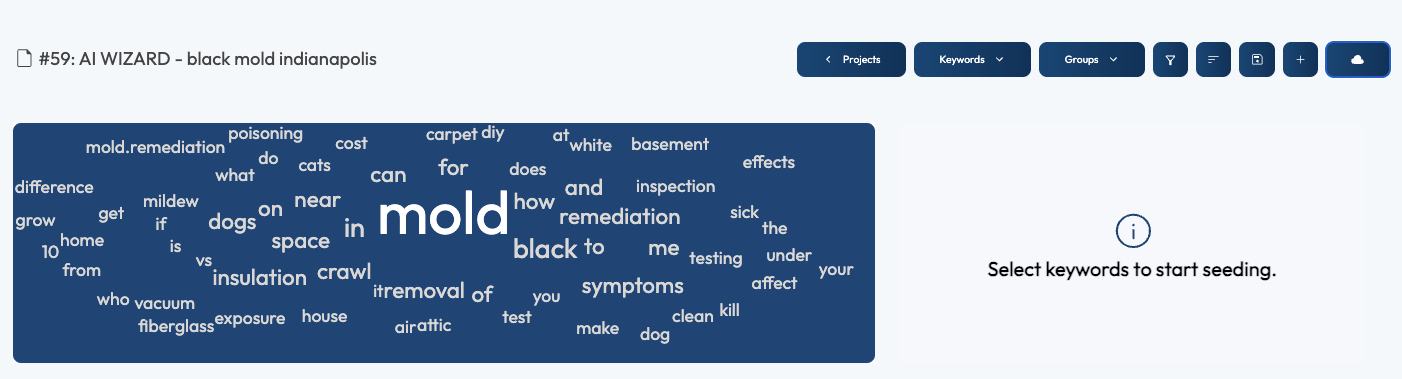
This allows me to identify high-level topics that I want to seed into groups.
Taking the above example, some immediate topics stand out for me that would be important for a local client or lead gen site, and I have selected them in the next screenshot.
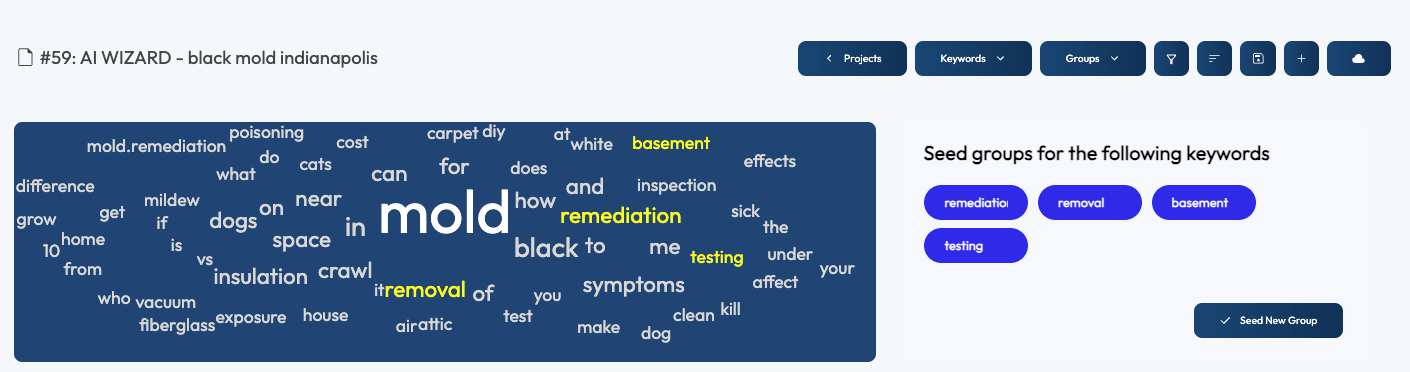
By selecting these words, I can then ask Xagio to seed them into new groups, and any keywords in the project that contain these selected words will be copied into those new groups.
Once that part is completed, it’s time to go through the clusters and manually review the keywords.
Sometimes, I find ones that fit better into a different group or ones that I want to split out into another separate group.
I’m so used to this process that it usually takes me just a few minutes, but I get that many people find this a slow process.
Plus, even I like saving 5 – 10 minutes on a repetitive task, and AI has made it possible to automate it.
Let me show you what my developers came up with.
Automated AI Clustering In Agent X
Agent X has the same clustering feature as the AI Wizard and Audit feature in Project Planner.
This automation is already pretty powerful, but it does generally require you to do some cleaning up, as I described above.
However, in Agent X, you now have the added AI Clustering feature when you get to the screen with the keyword groups.
Here’s what our proprietary AI prompt does:
“This prompt performs strict keyword clustering by normalizing all service, role, and location terms (e.g., singular form, merged synonyms for modifiers) and grouping them into unique clusters based on those normalized keys. It recursively audits and merges/splits clusters to ensure that no duplicates, missing assignments, or invalid merges (like true synonyms such as “attorney” and “lawyer”) exist, enforcing complete consistency and accuracy in the final output.”
The prompt behind the scenes took many days to refine, but it now mimics my entire thought process of manually seeding and clustering.
Here’s the best part.
Not only does it take just a few seconds to complete, but it typically costs you just 1 or 2 Xags.
That’s insanely cheap for something that could save you 20 minutes or more if you’re new to the process.
Pro Tip: Follow this help doc for a step-by-step guide to using AI Clustering.
Start Using Agent X Today
If you’ve ever struggled to build clean, optimized keyword groups or wasted hours second-guessing whether your clusters make sense, Agent X now does the heavy lifting for you.
We’ve trained our proprietary AI to mimic my exact thought process, saving you time while dramatically improving your site structure and topical authority.
Whether you’re building out a fresh campaign or cleaning up old keyword chaos, Agent X’s AI Clustering gives you an unfair advantage, without having to guess.
Sign up for a paid Xagio account today and put Agent X to work on your next project.